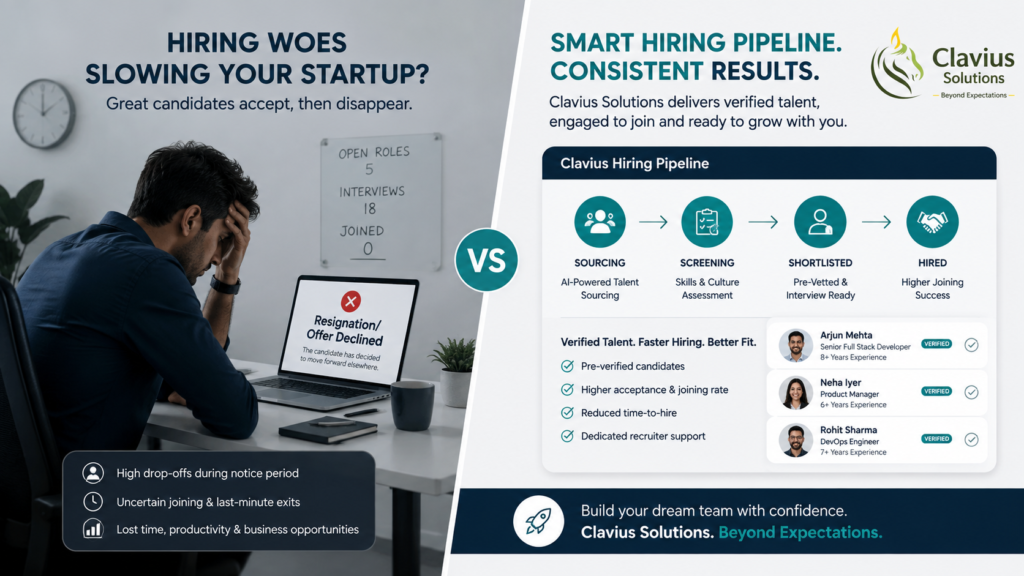
The biggest hiring challenge facing early-stage companies often peaks right after an offer is accepted: you screen dozens of applicants, run multiple interview loops, and extend an offer to an exceptional candidate who accepts with enthusiasm, only for momentum to stall.
Then, the clock starts ticking on their 90-day notice period.
By Day 45, their responses slow down. By Day 75, they stop replying altogether. On Day 90, instead of welcoming a new team member, you get a short email: “I’ve decided to pursue another opportunity.”
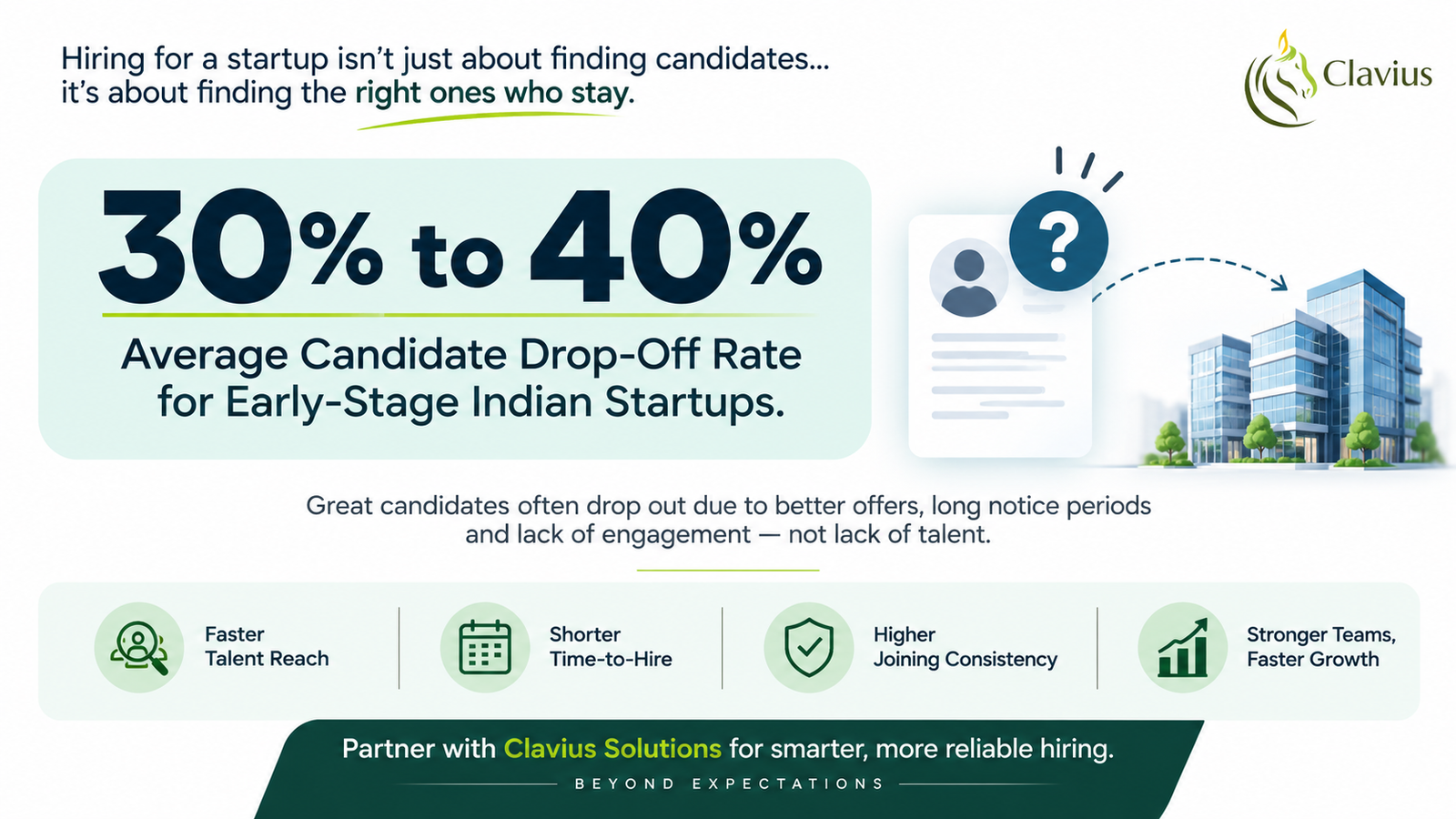
| CRITICAL INDUSTRY BENCHMARK 30% to 40% of selected candidates in early-stage Indian startups drop out before their joining date. |
The issue rarely stems from a lack of talent in the market. Instead, it comes down to structural flaws in how startups source, interview, and engage candidates post-offer. When key positions stay open for months, product roadmaps stall, existing teams burn out, and business growth slows.
Here is how to solve your recruitment hurdles by fixing these 5 critical mistakes.
How to Solve the Notice Period Hiring Challenge: Plug The 90-Day Talent Leak.
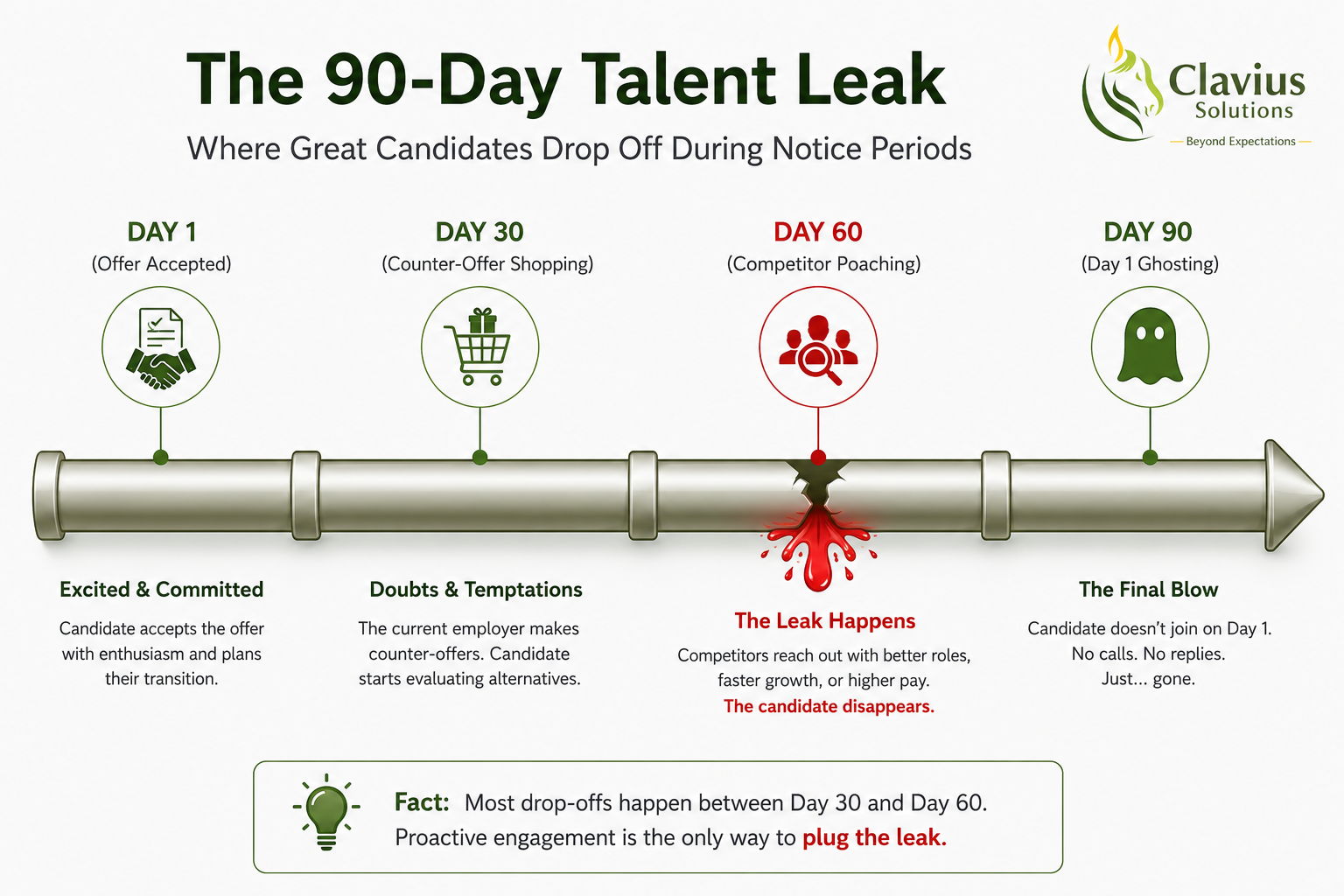
In India’s tech ecosystem, standard 60- to 90-day notice periods create a major vulnerability in your recruitment pipeline. Most founders assume that once an offer letter is signed, the hire is secured. In reality, the day an offer is accepted is when the real risk begins.
Candidate drop-offs typically follow a predictable timeline:
- Day 1 (Offer Accepted): The candidate is motivated, enthusiastic, and committed to making a transition.
- Day 30 (Counter-Offer Shopping): Their current employer offers a retention bonus or a promotion. Doubts kick in, and the candidate begins testing their market value using your offer as leverage.
- Day 60 (Competitor Poaching): External recruiters reach out with higher compensation packages or faster career progression. The candidate shifts their focus.
- Day 90 (Day 1 Ghosting): The candidate fails to show up on their start date, leaving your team back at square one.
How to Fix the Notice Period Challenge
Most candidate drop-offs occur between Day 30 and Day 60. To keep top candidates committed, shift from passive waiting to structured engagement:
- Maintain weekly touchpoints with incoming hires through informal team catch-ups or project context sessions.
- Involve them in key company announcements and strategy updates before their official start date.
- Implement structured candidate tracking systems that flag declining engagement early, allowing you to address concerns before an offer is rejected.
Stop Over-Indexing on Resumes and Brand Pedigree Hiring Challenge
A common mistake occurs when founders fall into the trap of hunting for “unicorn” candidates—professionals coming from big-tech backgrounds or prestigious institutions whose resumes match a long list of technical keywords.
However, corporate experience does not always translate to early-stage execution. A candidate accustomed to large teams, established processes, and abundant resources may struggle when asked to build systems from scratch in a fast-paced environment.
How to Evaluate Practical Execution Fit
- Replace generic technical questionnaires with practical, scenario-based evaluations tailored to your current technical goals.
- Evaluate candidates for adaptability, speed of problem-solving, and comfort with ambiguity.
- Focus on candidates who demonstrate high ownership and execution capacity rather than relying solely on brand-name pedigree.
Eliminate Slow, Multi-Stage Interview Loops
High-performing candidates rarely stay on the market for long. Another severe operational hurdle stems from recruitment processes involving five or six separate interview rounds spread over a month—causing you to lose top talent to agile competitors.
A drawn-out interview cycle sends two negative signals to candidates:
- Decision-making in your organization is slow and bureaucratic.
- Their time is not valued.
How to Compress Your Speed-To-Hire
To win competitive talent, streamline your assessment framework into a focused, highly coordinated timeline:
| THE 5-DAY FAST-TRACK SELECTION LOOP Day 1: Initial Sourcing & Practical Screening Day 2: Deep-Dive Technical / Core Competency Evaluation Day 3: Founders / Culture & Execution Alignment Round Day 4: Formal Offer Rollout Day 5: Offer Acceptance & Transition Planning |
By condensing your decision-making window, you maintain candidate momentum, project operational efficiency, and secure talent before rival offers materialise.
Fix Weak Post-Offer Engagement Strategies
When a candidate accepts an offer, they enter a period of transition uncertainty. Ignoring post-offer communication creates an avoidable point of failure, allowing competing recruiters to fill that communication void.
Candidates do not drop out simply because a competitor offered a slightly higher salary. They drop out because another company built a stronger relationship, demonstrated clearer growth opportunities, and maintained consistent communication throughout their notice period.
How to Build Structured Nurturing Workflows
- Day 1 to 15: Deliver onboarding documentation, share welcome kits, and introduce key team leads.
- Day 15 to 45: Set up bi-weekly check-ins with functional leaders to discuss upcoming goals and team culture.
- Day 45 to 75: Send early access to non-sensitive project roadmaps or team tools so they feel like part of the organisation before Day 1.
- Move Away From Reactive Panic Hiring
Panic hiring occurs when a critical team member leaves, or a project deadline looms, forcing you to fill a gap immediately. This creates a dangerous cycle where teams lower their standards, skip cultural alignment checks, and make rushed offers.
Panic hires frequently result in premature exits within six months, forcing you to repeat the entire hiring cycle while absorbing the financial and operational costs of a bad fit.
How to Build a Proactive Talent Pipeline
- Continuously build relationships with passive candidates in key roles (such as Full-Stack Developers, Product Managers, and DevOps Engineers) even when you are not actively hiring.
- Leveraging a specialized startup hiring consultancy or an experienced hiring firm for startups allows you to tap into pre-vetted, active candidate networks—dramatically reducing your time-to-hire when sudden gaps occur.
- Benchmark compensation packages against current market trends to ensure your offers remain competitive without overextending your budget.
Transforming Your Recruitment Process into a Growth Engine
Overcoming any startup hiring challenge does not require inflated compensation budgets or endless interview rounds. It requires a structured hiring engine focused on candidate engagement, rapid decision-making, and verified skill assessment.
| Traditional Recruitment Bottlenecks | Modern Sourcing & Pipeline Strategy |
| High Drop-Offs: Candidates vanish during 90-day notice periods | Active Engagement: Continuous communication plugs the “talent leak” |
| Slow Interview Loops: Multi-week cycles lead to lost candidates | Fast-Track Sourcing: Compressed 5-day loops secure top talent quickly |
| Uncertain Fit: Hiring based on resume buzzwords and pedigree | Practical Assessment: Evaluating real-world execution capacity |
| Reactive Sourcing: Scrambling to fill roles after exits occur | Pre-Vetted Pipelines: Maintaining ready-to-hire talent networks |
Frequently Asked Questions (FAQs)
Q: How can Indian founders reduce candidate drop-offs during 90-day notice periods?
Founders can prevent offer drop-offs during long notice periods by maintaining proactive engagement between offer acceptance and Day 1. This includes bi-weekly project check-ins, early team introductions, sharing non-sensitive technical roadmaps, and providing clear career growth visibility to counter competitor poaching.
Q: What is the average offer rejection rate for startups in India?
Early-stage Indian startups face an average candidate drop-off rate of 30% to 40%. Most offer rejections and ghosting occur between Day 30 and Day 60 due to counter-offers, competitor outreach, and lack of employer engagement during the notice period.
Q: How fast should a startup’s recruitment loop be?
A startup’s recruitment process should ideally take no longer than 5 to 7 days. Streamlining your hiring loop into 3 focused stages—practical screening, core skill evaluation, and founder alignment—keeps candidate momentum high and prevents them from accepting competing offers.
Q: Why should early-stage companies partner with a recruitment consultancy for startups?
A dedicated recruitment consultancy for startups understands early-stage execution risks and long notice period dynamics. Unlike traditional agencies, specialized startup hiring firms combine AI sourcing, practical skill benchmarking, and active pre-joining engagement to prevent candidate drop-offs before Day 1.
Q: How does Clavius Solutions improve startup recruitment success rates?
Clavius Solutions helps startups scale by providing pre-vetted candidates, AI-powered talent sourcing, structured skill verification, and automated notice-period nurturing to ensure high offer acceptance and Day 1 joining rates.
Solve Your Recruitment Roadblocks with Clavius Solutions
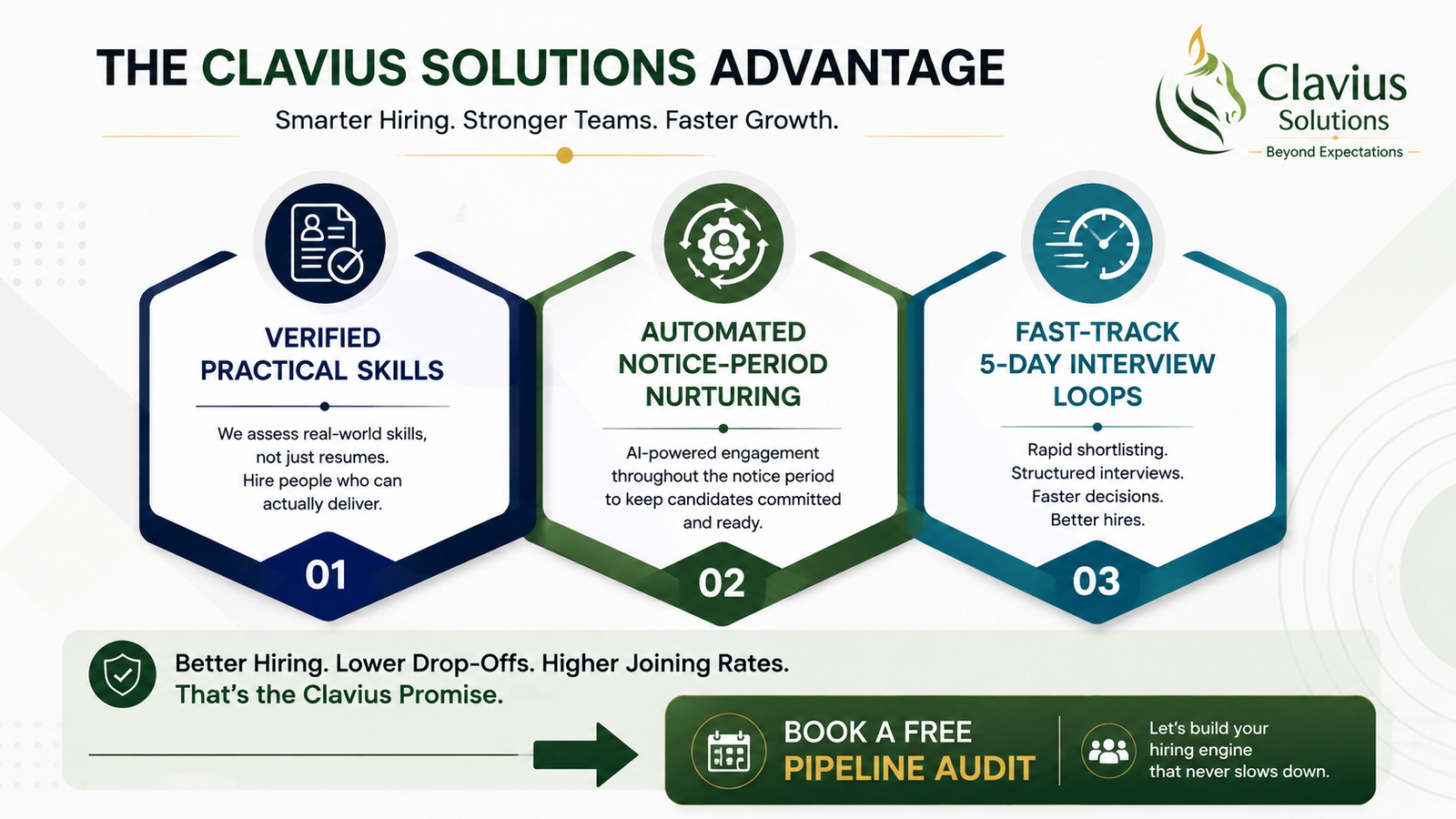
| As a leading startup hiring consultancy and talent acceleration partner, Clavius Solutions helps early-stage companies, fast-growing SMEs, and GCCs overcome every hiring challenge, eliminate candidate drop-offs, and scale high-performing teams with confidence.
Through AI-powered sourcing, rigorous skill verification, and automated notice-period engagement models, we ensure the candidates you offer are the candidates who join on Day 1. Ready to build a reliable talent engine and stop losing top candidates? |