Hiring looks straightforward on paper: define the position, post the job ad, screen applicants, conduct interviews, and extend an offer.
In practice, modern talent acquisition strategy rarely runs that smoothly. Highly qualified professionals are hard to find, urgent vacancies demand immediate start dates, high-volume hiring strains administrative bandwidth, and internal HR teams often run out of capacity.
Why do staffing agencies exist? They exist to bridge the gap between a company’s immediate recruitment needs and its available internal hiring resources. By offering direct access to passive candidate networks, specialized industry expertise, and flexible workforce models, an external recruitment partner helps businesses overcome critical talent bottlenecks.
Depending on your operational goals, a staffing agency can support permanent recruitment, contract staffing, temporary workforce management, bulk hiring drives, specialized IT recruitment, or full recruitment process outsourcing (RPO).
Why Do Staffing Agencies Exist?
At its core, a staffing agency exists because a company’s hiring volume and technical requirements frequently outpace its internal recruitment bandwidth.
An organization may have a capable internal HR team and still require an external staffing partner. There is no strategic contradiction here. While internal teams focus on employee relations, performance management, retention, and ongoing culture initiatives, sudden hiring spikes or niche searches require dedicated sourcing firepower.
A staffing agency takes ownership of complex hiring streams, keeping your time-to-fill and cost-per-hire optimized.
Partnering with an external recruitment provider becomes essential when facing:
-
Urgent hiring timelines tied to project go-lives
-
Sudden spikes in open requisitions
-
Niche, hard-to-fill technical skill requirements
-
Temporary, project-based, or seasonal workforce demands
-
Geographic expansion across multiple cities
-
Capacity constraints within the internal talent acquisition team
-
A strategic need for full or partial recruitment process outsourcing
Simply put, staffing agencies exist to connect commercial hiring demand with pre-vetted talent far more efficiently than an overburdened internal team can manage alone.
What Does a Staffing Agency Do for Businesses?
A staffing agency operates as an extension of your company’s talent acquisition team.
Instead of passively collecting applications, a dedicated recruiter analyzes the operational context of the role, understanding non-negotiable technical skills, cultural alignment, compensation benchmarks, and potential red flags.
Depending on the engagement model, an agency manages:
-
Passive Candidate Sourcing: Reaching beyond job boards into private professional networks and industry talent pools.
-
Rigorous Candidate Screening: Vetting candidate experience, technical capability, notice periods, and compensation fit.
-
Shortlisting & Logistics: Delivering fully evaluated profiles and coordinating multi-round interview schedules.
-
Offer & Onboarding Management: Maintaining active engagement during notice periods to minimize offer drop-outs and counteroffer risks.
The real value for an employer isn’t receiving a high volume of resumes—it’s receiving a sharp, highly relevant shortlist of pre-vetted professionals ready to execute.
Why Use a Staffing Agency? 7 Hiring Problems They Help Solve
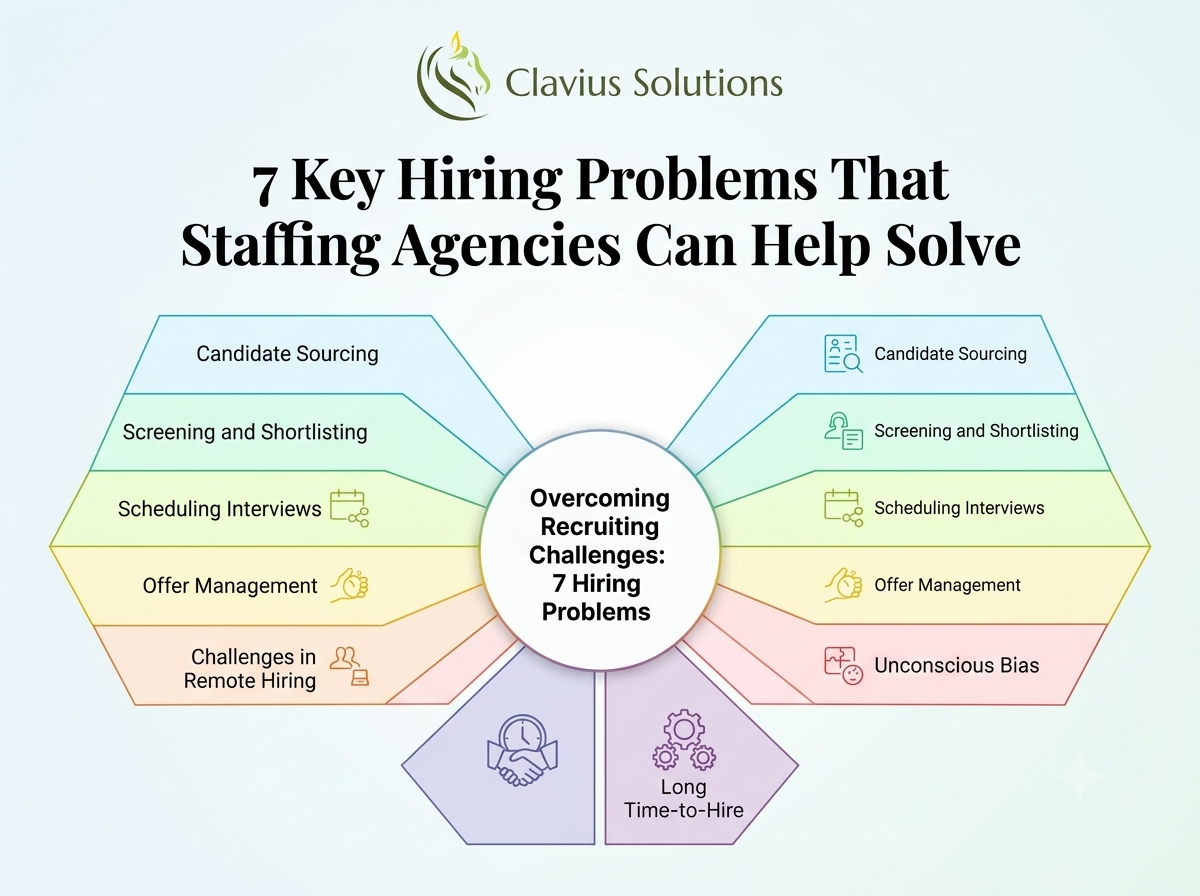
1. Finding the Right Candidates Takes Too Long
Standard job postings often generate hundreds of applications but very few qualified candidates. Internal recruiters can waste dozens of hours filtering irrelevant profiles just to build a basic shortlist.
A specialized staffing agency brings established talent pools and proactive headhunting methods to uncover passive job seekers. The focus shifts from managing high resume volume to engaging candidates who match your exact job specifications.
2. Business Needs People Quickly
Hiring delays directly impact project timelines, client deliverables, and team morale. When a key vacancy opens unexpectedly, an internal team already managing routine hiring may struggle to pivot fast enough.
Staffing partners deploy dedicated recruiters to accelerate the sourcing and screening stages, allowing hiring managers to make swift, confident selection decisions without derailing daily operations.
3. Company Has Bulk Hiring Requirements
Recruiting 2 professionals requires a completely different operational workflow than onboarding 50 employees simultaneously. High-volume hiring multiplies administrative complexity across candidate screening, document verification, interview scheduling, and offer management.
Structured bulk hiring services build a dedicated recruitment pipeline to help organizations scale headcount rapidly during facility launches, regional expansions, or new business line rollouts.
4. Role Requires Specialised IT or Technical Talent
Niche technical roles in areas like cloud infrastructure, data engineering, enterprise applications, cybersecurity, and AI require recruiters who understand the technology stack. A resume matching keywords does not guarantee real-world execution capability.
An experienced IT staffing service evaluates practical project experience and domain knowledge, ensuring candidate capabilities align with your hiring manager’s technical expectations.
5. Internal Recruitment Capacity Is Limited
Recruiter bandwidth is a finite resource. When internal HR professionals are forced to balance recruitment alongside performance reviews, compliance, payroll, and employee retention, quality suffers across the board.
Utilizing an external partner provides scalable recruitment capacity on demand, letting your organization handle temporary hiring spikes without permanently increasing fixed internal overhead.
6. Business Needs Contract or Temporary Staffing
Not every operational initiative warrants adding permanent headcount to the payroll. Companies frequently require qualified professionals for defined project timelines, seasonal workload surges, or maternity leave coverage.
Through contract staffing services, businesses maintain operational agility—scaling labor costs up or down in direct alignment with real-time business demand.
7. Hiring Is Required Across Multiple Locations
Managing talent acquisition in a single hub like Bengaluru is vastly different from running parallel hiring drives across Bengaluru, Hyderabad, Pune, Mumbai, Chennai, Noida, and all over India. Local talent availability, salary expectations, notice period norms, and candidate preferences vary significantly across different regional markets.
A multi-location staffing agency provides local market coverage, handling regional sourcing dynamics while maintaining a consistent candidate evaluation standard.
How Does a Staffing Agency Work?
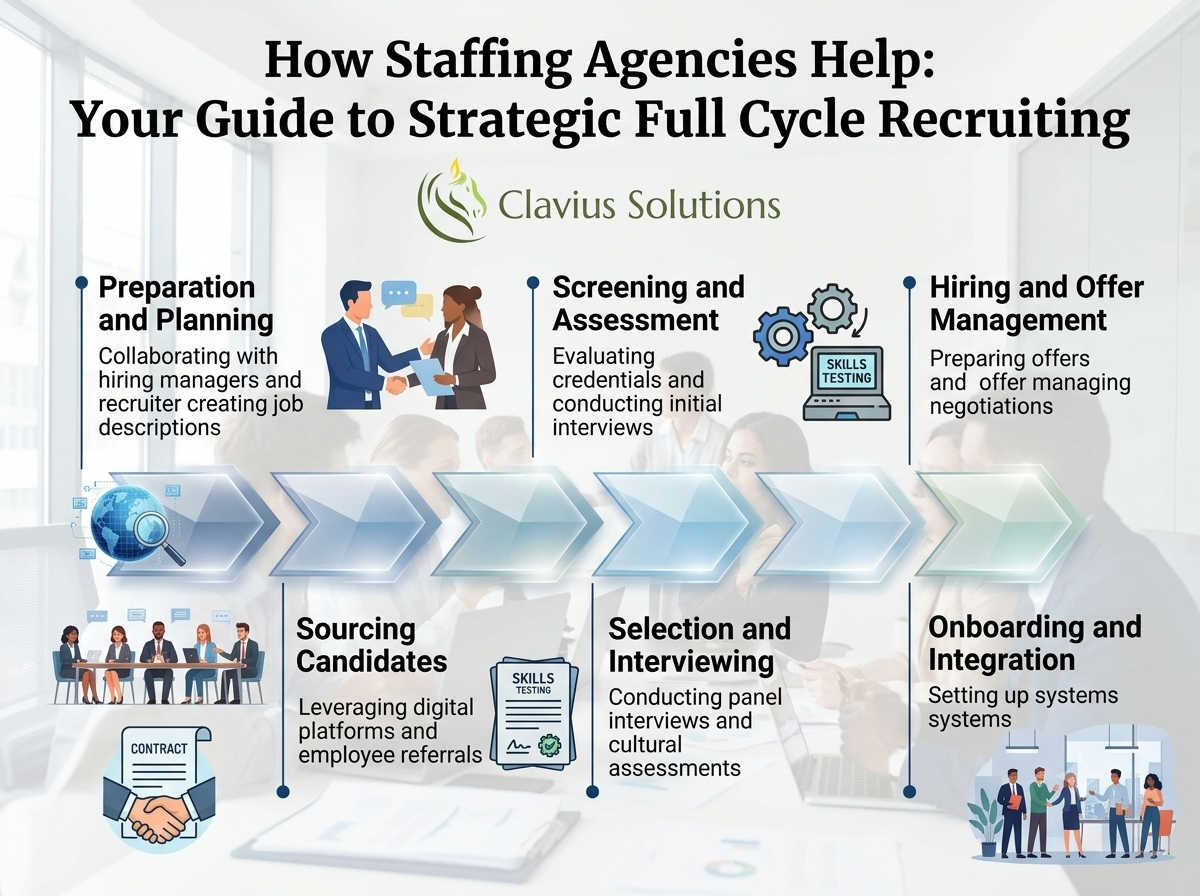
While every engagement is customized, a structured recruitment workflow typically moves through five key stages:
-
Requirement Scoping: Deep-diving into role expectations, required skills, team dynamics, budget parameters, and joining timelines.
-
Targeted Sourcing: Deploying direct outreach, industry referrals, passive databases, and specialized networks to identify candidates.
-
Structured Screening: Vetting candidate profiles for functional expertise, communication skills, compensation expectations, location fit, and notice period constraints.
-
Shortlist & Interview Coordination: Presenting pre-screened candidate profiles and managing interview schedules, feedback loops, and candidate expectations.
-
Offer & Notice Period Nurture: Maintaining continuous contact between offer acceptance and the joining date to mitigate counteroffers and drop-out risks.
What Should a Business Expect From a Staffing Agency?
Partnering with an agency should feel like a strategic collaboration, not a transactional vendor interaction. Before signing an agreement, insist on total operational transparency regarding:
-
Requirement Comprehension: Clear proof that the recruiter understands the practical responsibilities of the role, not just the job title.
-
Sourcing Methodology: Explicit details on where and how target candidates will be engaged.
-
Screening Rigor: A commitment to presenting pre-vetted, high-fit candidates rather than flooding your inbox with raw CVs.
-
Candidate Communication: Timely updates and candidate nurture throughout the interview and offer stages.
-
Transparent Commercial Terms: Unambiguous fee structures, payment schedules, service level agreements (SLAs), and candidate replacement guarantees.
Staffing Agency vs In-House Recruitment
Comparing key execution drivers across both approaches:
-
Routine Hiring: In-house teams excel at predictable, steady-state hiring; staffing agencies provide supplemental capacity during workload surges.
-
Urgent Vacancies: In-house timelines depend on current recruiter bandwidth; agencies deploy dedicated sourcing resources to shorten time-to-fill.
-
Bulk Hiring: In-house teams require temporary expansion to manage volume; agencies bring pre-built, scalable high-volume hiring infrastructure.
-
Specialised Roles: In-house reach is limited to internal recruiter networks; agencies leverage domain-specific recruiters and passive networks.
-
Contract Workforce: In-house execution relies on existing internal employment structures; agencies offer turn-key, compliant contract staffing solutions.
-
Multi-City Drives: In-house requires dedicated recruiters in every target hub; agencies offer immediate cross-regional sourcing networks.
What Staffing Services Do Businesses Use?
To match diverse organizational goals, staffing providers deliver several tailored service models:
-
Permanent Staffing: End-to-end recruitment tailored for long-term, core headcount growth.
-
Contract Staffing: Flexible workforce solutions structured around fixed project timelines or contractual terms.
-
Temporary Staffing: Immediate coverage to manage short-term operational spikes or leave coverage.
-
Bulk Hiring: Scaled recruitment processes engineered to onboard large teams within compressed timeframes.
-
Recruitment Process Outsourcing (RPO): Delegating specific hiring streams or the entire recruitment function to an external team.
-
IT & Specialized Staffing: Focused sourcing for technical disciplines including software engineering, cloud, data, AI, and cybersecurity.
-
Executive Search: Discrete, highly targeted headhunting for senior leadership and CXO-level roles.
How Much Does a Staffing Agency Cost?
Staffing agency pricing models vary based on the engagement structure, role complexity, hiring volume, seniority, skill scarcity, and market location.
-
Permanent Placement: Typically structured as a percentage of the hired candidate’s annual CTC (Cost to Company).
-
Contract Staffing: Generally operates on a markup or margin model over the monthly payroll cost.
Evaluating an agency solely on its percentage fee is an incomplete business metric. Leaders should weigh the agency fee against candidate quality, turnaround speed, replacement terms, and the ongoing business losses incurred by leaving critical positions vacant.
How to Choose a Staffing Agency for Your Business
When selecting an agency partner, look beyond generic claims about candidate database size. Evaluate whether the agency:
-
Takes time to thoroughly understand your business context before launching the search.
-
Demonstrates proven experience and active talent pipelines in your specific industry.
-
Employs a transparent, rigorous candidate evaluation and screening process.
-
Supports your required engagement model (permanent, contract, bulk, or RPO).
-
Understands regional talent trends in your target hiring hubs.
-
Operates with clear, fair commercial structures and candidate replacement guarantees.
How Clavius Solutions Approaches Recruitment
At Clavius Solutions, recruitment begins with understanding the true hiring challenge, not just collecting job descriptions and blasting back resume files. We analyze the role’s business impact, essential skills, market talent availability, and timelines before tailoring a search strategy.
When executing complex, hard-to-fill, or multi-location hiring drives across India, our delivery teams adapt to real-world talent market conditions rather than relying on a static, one-size-fits-all sourcing template. Our objective is to deliver a focused, highly relevant shortlist that aligns with your technical standards, culture, and business timeline.
Clavius Solutions supports growing enterprises with Permanent Recruitment, Contract Staffing, Bulk Hiring, IT & AI Recruitment, Non-IT Sourcing, Executive Search, and RPO solutions.
Why Do Staffing Agencies Exist? Understanding Their Business Value
So, why do staffing agencies exist?
They exist because a company’s talent acquisition needs change far faster than its internal HR capacity can scale.
Whether your organization needs to hire a specialized AI engineer, onboard 40 operational staff on short notice, or manage contract hiring across multiple cities, an external recruitment partner provides the flexibility and sourcing firepower needed to keep your operations moving forward.
The value of a staffing agency is not found in the number of resumes it delivers, but it is recognised in its ability to solve the specific hiring bottleneck slowing your business growth.
Ready to eliminate your hiring bottlenecks?
If your organization is managing urgent vacancies, niche technical roles, or complex multi-location hiring drives, connect with Clavius Solutions today to build a recruitment strategy tailored to your growth goals.
Frequently Asked Questions (FAQS)
1. Why do staffing agencies exist?
Why do Staffing agencies exist because they help businesses find, screen, and hire qualified employees more efficiently. They connect employers with suitable candidates for permanent recruitment, contract staffing, temporary staffing, and bulk hiring, reducing the time and effort involved in recruitment.
2. What is the purpose of a staffing agency?
The primary purpose of a staffing agency is to bridge the gap between employers and job seekers. A staffing agency manages candidate sourcing, screening, interview coordination, and recruitment support so companies can focus on their core business.
3. How do staffing agencies help employers?
Staffing agencies help employers reduce time-to-hire, access a wider talent pool, and manage changing workforce requirements. They can support businesses with contract staffing, permanent staffing, bulk hiring, specialised recruitment, and hiring across multiple locations.
4. Why do companies use staffing agencies instead of hiring directly?
Companies use staffing agencies when they need faster hiring, specialised talent, flexible workforce solutions, or support with high-volume recruitment. A recruitment agency can handle much of the sourcing and screening process, helping internal HR teams manage recruitment workload more effectively.
5. When should a company use a staffing agency?
A company should consider using a staffing agency when it has urgent hiring requirements, multiple vacancies, difficult-to-fill positions, seasonal workforce needs, or limited internal recruitment capacity. Staffing agencies can provide flexible recruitment solutions based on the company’s hiring volume and business requirements.