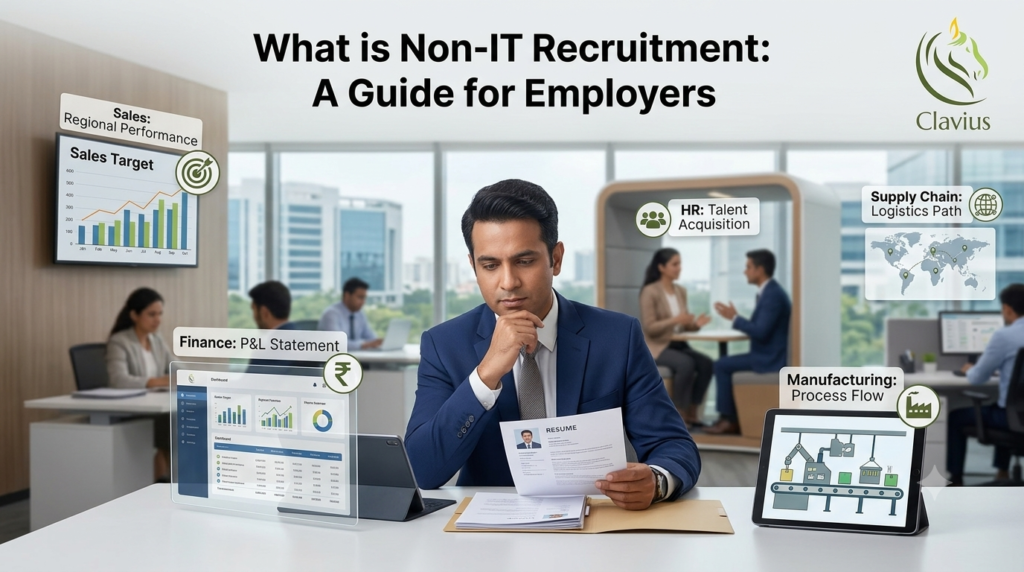
What is Non-IT recruitment? is the process of identifying, screening, and hiring professionals for business functions outside core IT roles. A non-IT vacancy can stay open for weeks even when candidates are available.
The problem is not always a shortage of talent. Sometimes the role requires a combination of experience, industry background, location, salary, notice period, and skills that very few candidates in the market can offer at the same time.
That is why non-IT recruitment needs more than simply posting a job and collecting resumes. Employers need to understand the role, the available talent pool, and which requirements are genuinely essential.
Non-IT recruitment covers professionals across sales, finance, HR, operations, manufacturing, procurement, supply chain, healthcare, retail, administration, and other business functions.
What Is Non-IT Recruitment?
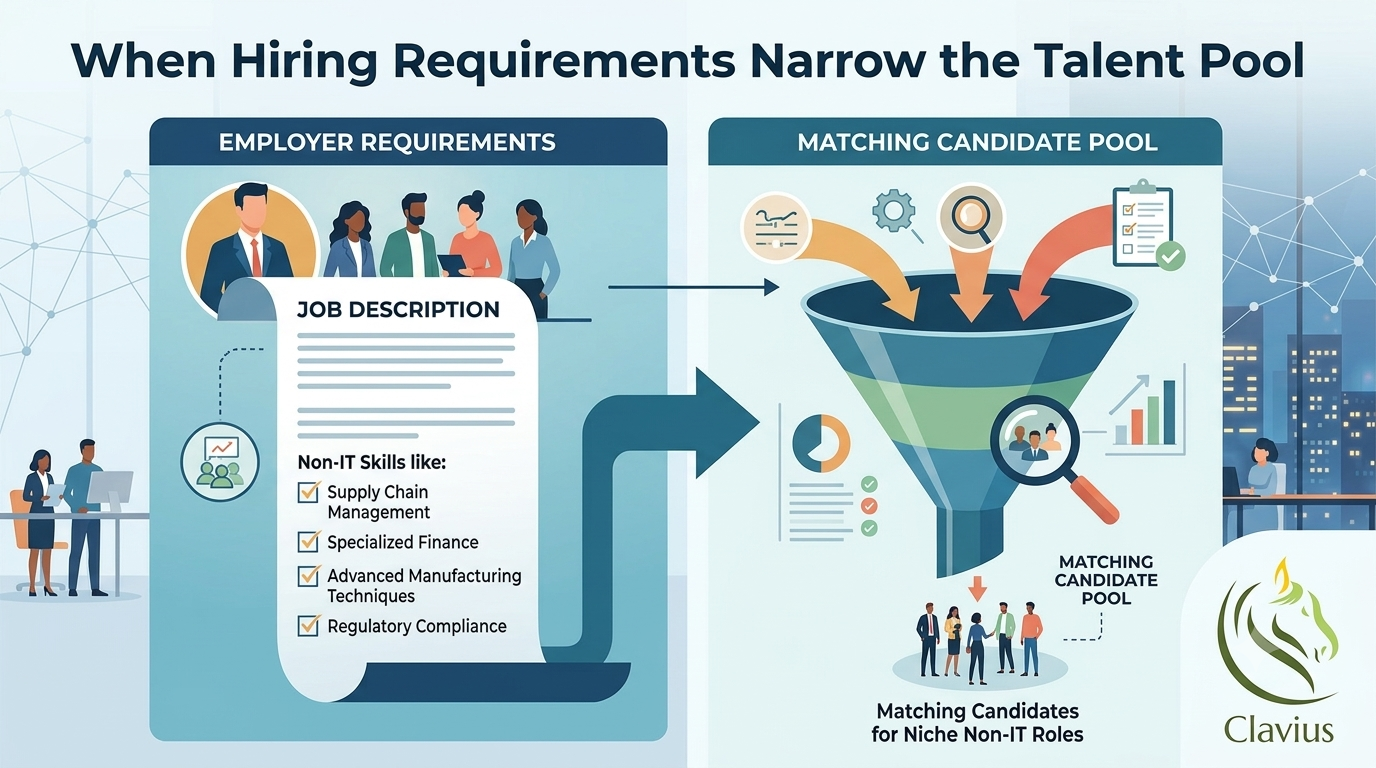
Non-IT recruitment is the process of identifying, screening, and hiring candidates for business functions outside core information technology roles.
Depending on the organisation, non-IT hiring may include:
- Sales and business development
- Finance and accounting
- Human resources
- Administration
- Operations
- Manufacturing and production
- Plant and shopfloor roles
- Procurement
- Supply chain and logistics
- Quality
- Healthcare
- BFSI
- Retail
- Marketing
- Customer service
- Legal and compliance
- Infrastructure and engineering
A finance manager, sales leader, and plant supervisor may all be non-IT hires, but each role requires a very different mix of skills, experience, and industry knowledge.
A sales manager may need experience with a particular territory and customer segment. A finance professional may need specific ERP or regulatory experience. A plant supervisor may need hands-on manufacturing experience and the ability to manage shifts and shop floor operations.
That is why non-IT recruitment should start with what the person will actually be expected to do, rather than relying on the job title alone.
How Is Non-IT Recruitment Different From IT Recruitment?
IT recruitment often involves assessing technical skills, programming languages, platforms, certifications, and project experience.
Non-IT recruitment can involve a broader mix of functional knowledge, industry exposure, commercial understanding, and operational experience.
Consider a few examples.
A procurement professional may need experience in vendor management, negotiations, category management, and cost control.
A manufacturing professional may require production experience, safety awareness, shift flexibility,y and workforce management.
A sales leader may need experience with a particular product category, customer segment, territory, sales cycle, and revenue responsibility.
The assessment therefore needs to reflect the role. A standard checklist rarely works equally well across different non-IT functions.
Which Roles Are Covered by Non-IT Recruitment?
There is no fixed list of non-IT jobs. Requirements depend on the organisation, industry and level of responsibility.
Sales and Business Development
Roles can range from sales executives and business development professionals to sales managers and commercial leaders.
Relevant experience may depend on the product, territory, customer segment, sales cycle and revenue responsibility.
Finance and Accounting
Organisations may recruit accountants, finance executives, finance managers, controllers, taxation professionals and audit specialists.
Industry exposure, ERP knowledge and regulatory experience may influence the selection process.
HR and Administration
Non-IT recruitment can include HR executives, recruiters, HR business partners, payroll professionals, administration managers and HR leadership roles.
Manufacturing and Operations
Recruitment may cover production, quality, maintenance, plant operations, operations management and shopfloor positions.
For these roles, practical industry experience can be as important as formal qualifications.
Procurement, Supply Chain and Logistics
Companies may require professionals in procurement, vendor management, warehousing, logistics, planning and supply chain management.
Other Business Functions
Depending on the organisation, hiring may also cover healthcare, BFSI, retail, marketing, customer service, legal, compliance, infrastructure and other specialist functions.
Why Is Non-IT Hiring Sometimes Difficult?
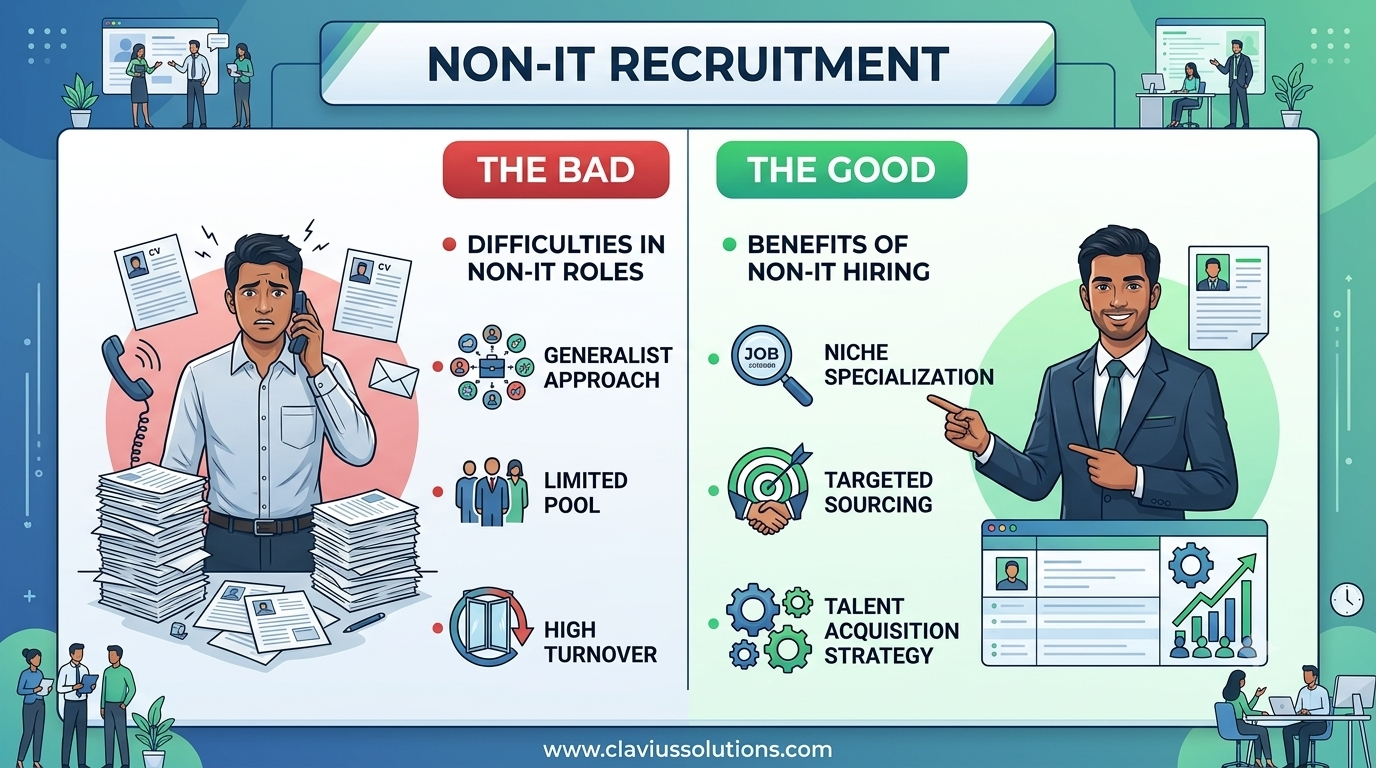
A difficult vacancy does not automatically mean that suitable candidates are unavailable.
Sometimes the difficulty comes from the combination of requirements.
For example, an employer may ask for:
- Specific industry experience
- A particular qualification
- Several years of experience
- Experience with a specific system
- Local availability
- Immediate joining
- A fixed salary range
Each condition may appear reasonable by itself. When all of them become mandatory, the available candidate pool can become very small.
Salary and Experience May Not Match
A role requiring substantial experience or specialist knowledge may attract limited interest when the compensation does not match the expectations of that talent pool.
Location Can Reduce the Candidate Pool
A suitable candidate may be available in another city but unwilling to relocate or accept a long commute.
Notice Period Can Become a Constraint
Experienced professionals may have longer notice periods. If the employer requires immediate joining, many otherwise suitable candidates may be excluded.
Industry Experience Can Be Too Narrow
Industry experience can matter, but making it an absolute requirement may remove candidates with strong transferable functional skills.
The question is whether the industry background is genuinely necessary for successful performance.
When Does a Hiring Requirement Become Too Restrictive?
This is worth examining when a vacancy remains open despite repeated sourcing.
Suppose several candidates have the required functional experience and seniority but miss one preferred criterion.
The employer needs to ask:
Does that criterion affect the person’s ability to do the job, or is it simply a preference?
The same question can apply to location, industry background, notice period, qualifications, and specific software experience.
A useful way to review a requirement is to separate:
Must-have requirements — criteria that are essential for the person to perform the role.
Nice-to-have requirements — criteria that would be useful but can potentially be learned or substituted with related experience.
This is not about lowering hiring standards. It is about making sure the standards are connected to the actual responsibilities of the position.
Why More CVs Do Not Always Solve a Hiring Problem
Sending more resumes does not automatically improve recruitment.
If an employer receives 50 profiles and only two are relevant, receiving another 100 profiles may simply create more screening work.
Before increasing sourcing volume, employers should ask:
- Are we reaching the right talent pool?
- Are the mandatory requirements realistic?
- Is the compensation appropriate?
- Are candidates rejecting the role for the same reason?
- Is location limiting interest?
- Is the hiring process taking too long?
- Are we overlooking candidates with transferable experience?
These questions help identify where the problem actually sits.
It could be talent availability. It could be sourcing. It could be the candidate specification. It could also be compensation or the hiring process.
That distinction matters because each problem requires a different response.
How Does a Non-IT Recruitment Agency Help?
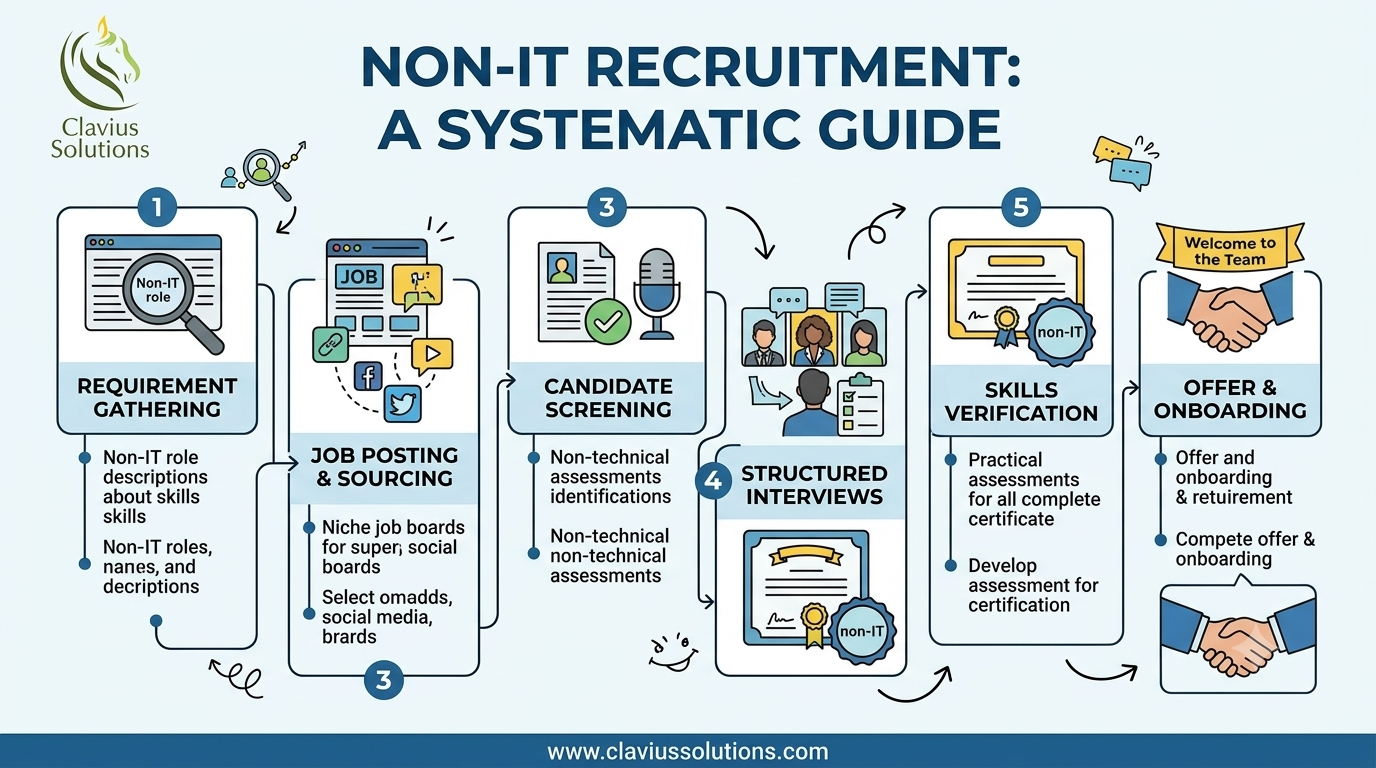
A non-IT recruitment agency can support employers at different stages of the hiring process.
Understanding the Requirement
The recruiter needs to understand the responsibilities, essential skills, experience, location, compensation, and expected joining timeline.
Finding Relevant Candidates
Sourcing can then focus on the talent pools most relevant to the position instead of relying only on general applications.
Screening Candidates
Candidates can be assessed against functional experience, industry background, compensation expectations, location, notice period, and interest in the opportunity.
Shortlisting
Relevant profiles are presented to the employer for further assessment.
Interview and Offer Coordination
The recruitment partner may coordinate interviews, collect feedback, communicate with candidates, and support the process through offer acceptance and joining.
The purpose is not to maximise the number of resumes sent to the employer. It is to reduce time spent searching and reviewing candidates who do not fit the requirements.
When Should a Company Use Non-IT Recruitment Services?
External recruitment support can make sense when a company:
- Has several vacancies to fill
- Needs additional sourcing capacity
- Has a difficult-to-fill position
- Requires specialised functional talent
- Is entering a new location
- Has limited internal recruitment bandwidth
- Needs bulk hiring support
- Requires targeted search for experienced professionals
- Is hiring across multiple cities
- Needs permanent or contract staffing
It is not necessary for every vacancy.
If an internal HR team already has a strong candidate pipeline, sufficient recruitment capacity, and access to the required talent, direct hiring may be more practical.
The decision should depend on the hiring problem rather than the assumption that every vacancy requires an external agency.
How Can Employers Improve Non-IT Hiring?
Before increasing recruitment activity, review the requirement itself.
Define the essential criteria.
Separate the skills required to perform the job from preferences that would simply be useful.
Check the market.
Find out whether candidates with the required combination of skills, experience, location, and compensation are actually available.
Review compensation.
Pay expectations need to make sense for the experience and responsibility being requested.
Consider transferable skills.
A candidate from a related industry may have the right functional capability even without identical sector experience.
Reduce unnecessary delays.
Strong candidates can move on when interviews, decisions, and feedback take too long.
Use targeted sourcing for specialist roles.
Some positions require direct and focused candidate search rather than relying only on job advertising.
Non-IT Recruitment in Bangalore and Across India
Bangalore has a diverse employment market covering corporate offices, manufacturing, financial services, healthcare, retail, logistics, professional services, and other business sectors.
Non-IT recruitment requirements can therefore range from corporate and managerial positions to operational and plant-level roles.
For employers looking for non-IT recruitment services in Bangalore, Clavius Solutions supports recruitment and staffing requirements across business functions and locations.
Employers specifically looking for a Non-IT Job Consultancy in Bangalore can explore Clavius Solutions’ dedicated service page for more information.
Conclusion
What is Non-IT recruitment? Non-IT recruitment covers a wide range of functions, industries, and professional levels. The hiring challenge is therefore not always about finding more candidates.
In many cases, the more useful question is whether the role requirements, talent market, compensation, location, and hiring timeline are aligned.
Reviewing those factors can show whether the problem is genuinely a shortage of talent or whether the hiring criteria are making the search unnecessarily narrow.
For companies dealing with difficult-to-fill positions, multiple vacancies, specialised recruitment, or limited internal sourcing capacity, a non-IT recruitment partner can provide additional hiring support.
Clavius Solutions provides recruitment and staffing support for non-IT and other business functions across Bangalore and other locations in India.
Frequently Asked Questions About Non-IT Recruitment
What is non-IT recruitment?
Non-IT recruitment is the process of sourcing, screening, and hiring candidates for business functions outside core information technology roles, including sales, finance, HR, operations, manufacturing, supply chain, healthcare, and retail.
How is non-IT recruitment different from IT recruitment?
IT recruitment often focuses heavily on technical skills and technology experience. Non-IT recruitment may place greater emphasis on functional expertise, industry knowledge, operational experience, customer exposure, and business responsibilities.
Why are some non-IT positions difficult to fill?
A position can become difficult to fill when the combination of skills, experience, industry background, compensation, location, and joining timeline significantly reduces the available candidate pool.
How can an employer know whether a hiring requirement is realistic?
Employers can examine candidate availability, compensation expectations, location constraints, and the response received from the market. If suitable candidates repeatedly miss one non-essential criterion, that requirement may need reconsideration.
Can a recruitment agency handle non-IT bulk hiring?
Yes. Recruitment agencies can support bulk hiring by helping with candidate sourcing, screening, interview coordination, and follow-up across one or more non-IT functions.
Is non-IT recruitment limited to Bangalore?
No. Non-IT recruitment can support employers across different cities and regions depending on the requirement, talent market, and recruitment partner’s sourcing capability.