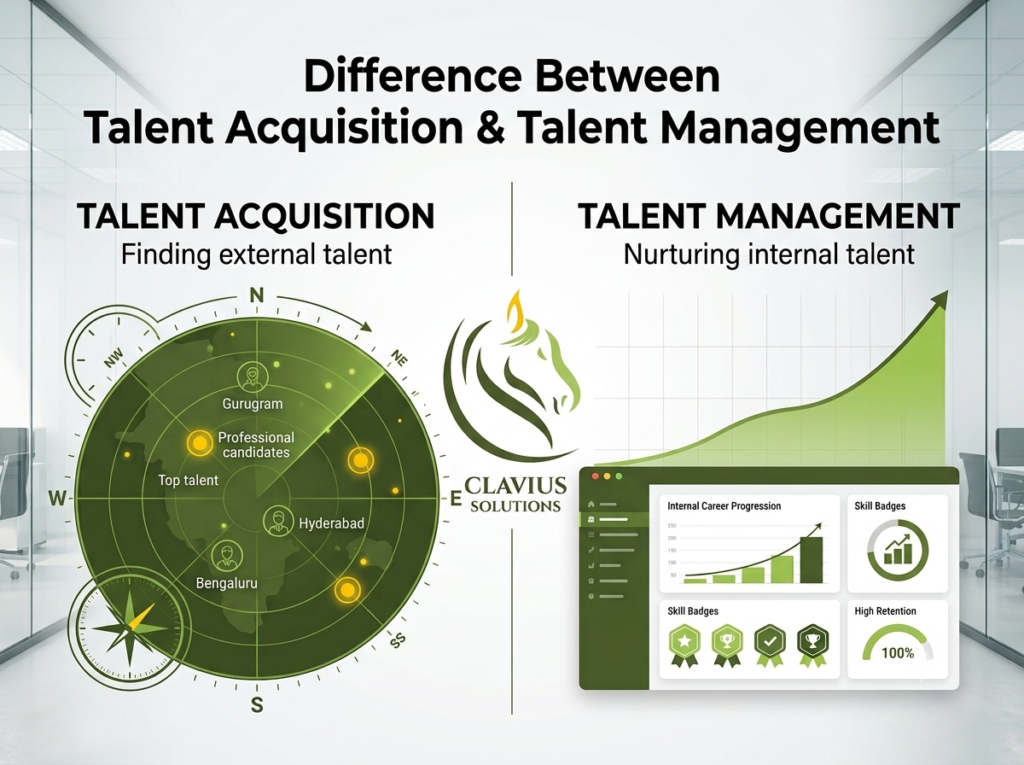
The actual difference between talent acquisition and talent management usually hits leadership at the absolute worst moment, like when a critical candidate ghosted your team two days before day one, or a senior lead resigned six months in because a competitor dangled a quick salary bump.
If you run a business in Bengaluru, Mumbai, Pune, Chennai, Ahmedabad, Hyderabad, or Gurugram, you know this pain firsthand.
A tech client in Bengaluru once told us they lost four senior devs in a single month during a 90-day notice period. They thought they had a recruitment problem. They did not, but they had a massive retention and candidate engagement problem.
Lumping these situations into a vague “HR issue” is a costly mistake. The root cause is almost always conflating two completely different functions: talent acquisition and talent management.
One gets talent through your door; the other stops them from leaving out the back door six months later.
Structural Difference Between Talent Acquisition and Talent Management
You have to draw a hard line between what happens before someone signs an offer letter versus what happens after their first day.
Defining Talent Acquisition in Modern HR
Standard recruiting is purely reactive. A desk opens up, panic sets in, you dump a generic job post on LinkedIn, and you filter through hundreds of bad resumes trying to fill a seat.
The difference between Talent Acquisition and Talent Management is that Talent Acquisition is proactive positioning. It means figuring out where your business needs to expand over the next two or three years and building real relationships with passive candidates today. That way, when a niche role opens up, you already know who to call instead of starting from zero. It combines employer branding, market intelligence, candidate experience, and long-term workforce planning.
Defining Talent Management for Retention
The difference between talent acquisition and Talent Management is that talent management kicks in the second an offer is signed. It’s the framework built to onboard, upskill, engage, and retain the people you spent months recruiting.
If talent acquisition fills your talent reservoir, talent management is the engineering that plugs the leaks in your pipe. It covers early onboarding, continuous performance feedback, leadership development, and succession planning for critical management roles.
Where Talent Resource Management Fits In
Talent resource management sits in the middle as the tactical allocator—dealing with how you deploy human capital across active projects day-to-day. In fast-paced sectors like IT services, GCCs, automotive, BFSI, or management consulting, resource management keeps key players assigned to high-impact work without burning them out, while keeping unassigned bench time close to zero.
Key Operational Differences Between Talent Acquisition and Talent Management
While both functions share a baseline goal—growing your company through great people—their daily execution looks completely different.
Talent acquisition looks outward at the broader job market. It’s an active outreach engine built to convince top external talent to leave their current employer. Talent management turns inward, focusing entirely on existing staff by setting up promotion pathways and skill frameworks so your best people don’t feel forced to job-hunt.
Their metrics prove how different they are too. Acquisition teams track time-to-fill, cost-per-hire, offer acceptance ratios, and sourcing channel efficiency. Talent management success shows up elsewhere: voluntary turnover rates, internal promotion velocity, employee net promoter scores (eNPS), and leadership bench strength.
Put simply: TA solves immediate capacity bottlenecks (like needing four cloud architects for a client project next month). TM builds long-term capability—ensuring that if a VP steps down next quarter, an internal director is already qualified to step in without disrupting operations.
Is Talent Acquisition Simply a Subset of Talent Management?
On a whiteboard? Sure. In a mature HR org, talent acquisition acts as the top-of-funnel entry point for the broader talent management lifecycle. You can’t retain or promote high-performing employees if your acquisition engine brings in people who don’t fit the role or culture to begin with.
Where growing companies stumble, though, is making a single, overburdened HR team handle both.
When you bundle TA and TM together, immediate hiring emergencies eat up every hour of the workday. Interview scheduling, candidate follow-ups, and salary negotiations naturally push long-term priorities—like updating performance review systems or mapping career progression paths—to the bottom of the list.
Why Indian Market Realities Highlight the Difference Between Talent Acquisition and Talent Management
Managing human capital in India comes with specific friction points that make separating TA and TM a non-negotiable operational necessity.

The 60 to 90-Day Notice Period Problem
Extended notice periods are standard across Indian commercial hubs like Bengaluru, Chennai, Pune, Mumbai, and Hyderabad. A candidate who signs your offer today might not step through your doors for three months. Standard recruitment setups go silent during this quarter-long gap, leading to sudden offer dropouts as candidates collect counter-offers. A dedicated talent acquisition strategy runs continuous pre-boarding engagement to keep hires committed until day one.
Regional Competition Driving the Need for TA and TM Integration
Hiring conditions vary heavily depending on geography:
- Bengaluru, Hyderabad & Gurugram: Global Capability Centers (GCCs) actively bid up salaries for niche tech skills in cloud, AI, and cybersecurity, competing directly with domestic firms for the same talent pool.
- Chennai: A major cluster for SaaS, automotive engineering, and expanding GCC operations that demands deep technical sourcing tied to structured retention frameworks.
- Mumbai: Fast-paced BFSI, fintech, and corporate headquarters demanding rapid executive search combined with high-touch management retention.
- Pune & Ahmedabad: Surging IT corridors, pharma, and industrial manufacturing ecosystems requiring specialized domain sourcing paired with clear internal career pathing.
Without dedicated talent acquisition, you won’t win top candidates in these competitive markets. And without talent management, local competitors will simply poach them a few months later.
How Talent Acquisition and Talent Management Work Together
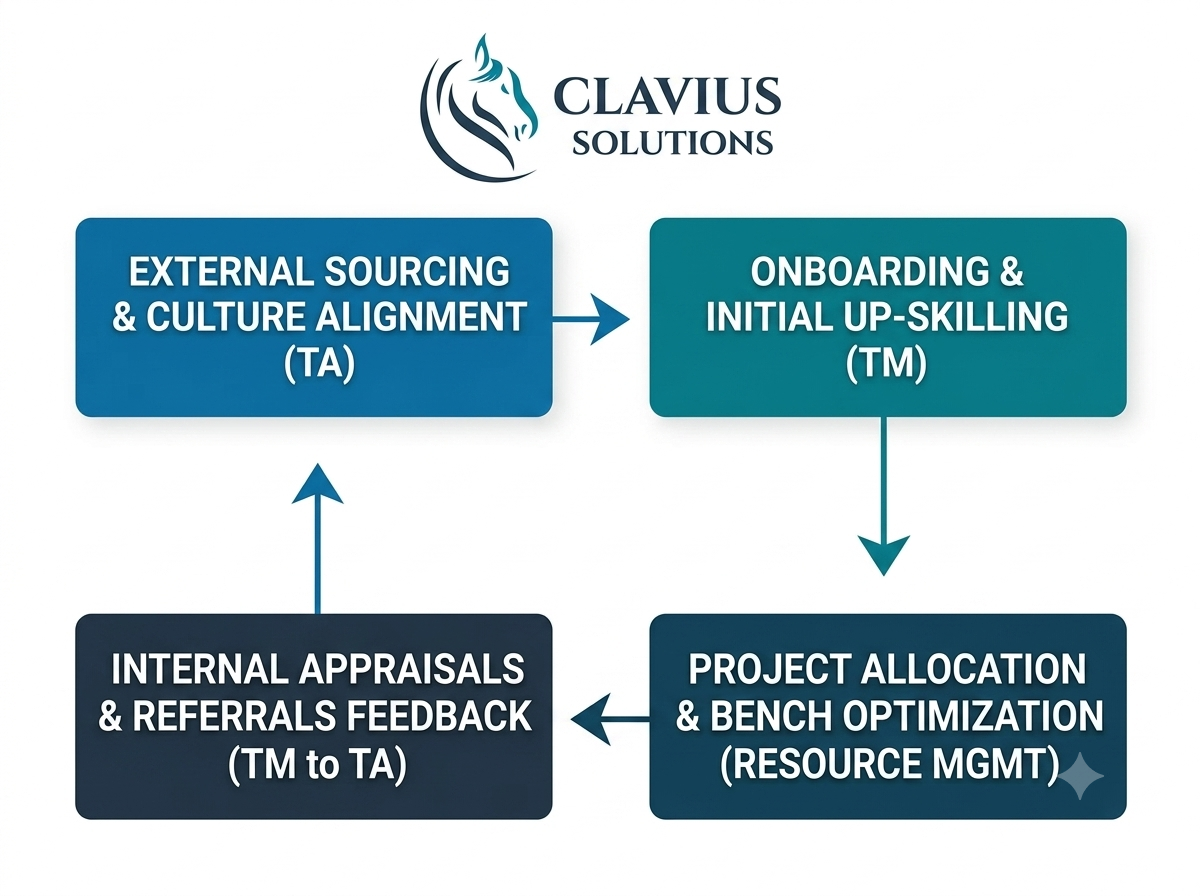
When both functions run effectively, they feed into each other in a natural feedback loop.
Talent management identifies upcoming skill gaps during appraisal cycles, giving talent acquisition advance notice to map out proactive candidate pipelines. Next, when talent acquisition hires for cultural alignment alongside technical capability, talent management has a much easier time keeping those hires engaged long-term. Finally, satisfied and well-managed employees generate positive word-of-mouth and refer past colleagues, which makes external sourcing far easier for your acquisition team.
When to Seek External Talent Acquisition Services
Internal HR teams eventually run into capacity limits when company growth outpaces hiring bandwidth. Trying to force an overworked internal team to scale up usually results in rushed hiring decisions, poor cultural fits, and recruiter burnout.
Operational Signals You Have Outgrown Your Internal Setup
- Critical technical or leadership roles sitting vacant quarter after quarter.
- Frequent candidate ghosting or dropouts right before joining dates.
- Heavy reliance on passive job board postings instead of active headhunting for niche roles.
- Rapid multi-city expansion across regions like Chennai, Mumbai, Pune, Ahmedabad, Bengaluru, or Hyderabad that your internal team can’t process alone.
When these bottlenecks hit, and you don’t know the difference between talent acquisition and Talent Management, partnering with an established recruitment consultancy or leveraging specialized talent acquisition services keeps your hiring momentum intact.
Partnering with External HR Specialists
Balancing aggressive market sourcing with internal employee engagement—without blowing out your overhead—is tough for growing companies.
Partnering with an established HR consultancy like Clavius Solutions allows your internal HR team to stay focused on culture, performance, and retention. Meanwhile, external domain specialists handle complex tasks like market mapping, executive headhunting, and pre-boarding engagement.
Whether your organization requires targeted IT recruitment, specialized GCC hiring frameworks, or full-scale recruitment services, having the right partner ensures your candidate pipeline stays predictable and high-quality.
Frequently Asked Questions
What is the main difference between talent acquisition and talent management?
The primary difference between talent acquisition and talent management: Talent acquisition is an outbound function focused on sourcing, interviewing, and hiring external candidates. Talent management is an internal function focused on onboarding, developing, performance mapping, and retaining employees after they join.
What is the difference between recruitment and talent acquisition?
Recruitment is a short-term, reactive push to fill an immediate open seat. Talent acquisition is a broader, long-term strategy centered on building talent pipelines, employer positioning, and candidate relationships for ongoing business needs.
Why do Indian companies experience high candidate offer dropouts?
Notice periods of 60 to 90 days across major hubs like Chennai, Mumbai, Pune, and Bengaluru give candidates ample time to leverage offers for counter-offers. Without an active pre-boarding strategy—a core part of modern talent acquisition—companies frequently lose hires before day one.
Can a growing business handle both functions with a single HR generalist?
In small teams under 40 people, a single HR generalist can usually manage both. Once you scale past 50 to 100 employees, constant hiring demands inevitably crowd out long-term retention work. Splitting the responsibilities or partnering with an external recruitment agency becomes necessary.
How does strong talent management lower overall hiring costs?
Effective talent management improves employee retention rates. Keeping your best people reduces unexpected open seats, lowering urgent sourcing costs, external agency spend, and productivity losses tied to open roles.
Build a Predictable Talent Pipeline for Your Business
Scaling an enterprise requires a clear, deliberate strategy for finding—and keeping—the right people.
Clavius Solutions works alongside growing businesses across India to streamline recruitment workflows, eliminate pre-joining dropouts, and secure top-tier talent across IT, non-IT, and leadership functions.
Contact the Clavius Solutions team today to discuss your hiring goals and build a talent acquisition framework tailored to your business.